
Description
As data sharing becomes increasingly essential to scientific research, many scientists find that existing technologies fall short, especially when it comes to collaboration across diverse teams. Our research reveals that while tools like Google Drive are widely used, they lack the fine-grained, discoverable controls needed for effective and secure sharing within scientific collaborations.
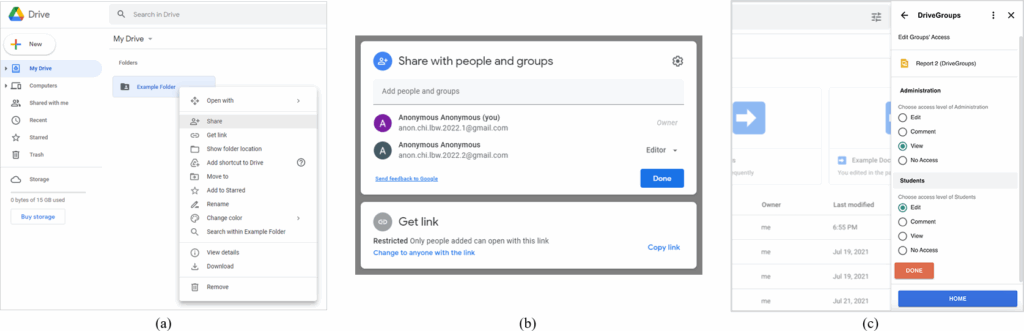
We are addressing this gap with DriveGroups, a Google Drive add-on that streamlines data sharing through role-based access control. DriveGroups enables researchers to easily manage file permissions across an entire project or lab, setting intuitive, transparent defaults for different roles (e.g., PIs, co-PIs, students). Unlike traditional systems, DriveGroups presents access settings through a simple, sidebar-based interface, making it easy to understand who has access to what and why.
This work is grounded in rigorous research. Through ethnographic interviews and observational studies with 38 academic researchers, we identified key pain points in current practices, including the difficulty of balancing security with collaboration and limited awareness of available access control features. In usability testing, DriveGroups matched or outperformed standard Google Drive in terms of ease of use, clarity, and effectiveness.
This research is part of a broader investigation into the sociotechnical challenges of data sharing in life sciences. Our goal is to ensure that powerful access control does not come at the cost of usability, and that tools are built to support the real needs of scientists working on high-impact, multidisciplinary research.
DriveGroups puts usability first, so scientists can focus on discovery, not file permissions.
Demonstration Video
Publications
J. G. Frazier, E. K. Weinstein, I. Izydorczak, Y. Wu, N. Cuadros, D. A. Sur, and S. Morrison-Smith. 2025. DriveGroups: Using Group Perspective for Usable Data Sharing in Research Collaborations. Proc. ACM Hum.-Comput. Interact. 9, 1, Article GROUP13 (January 2025), 28 pages. https://doi.org/10.1145/3701192
S. Morrison-Smith, C. Boucher, A. Sarcevic, N. Noyes, C. O’Brien, N. Cuadros, and J. Ruiz. 2022. Challenges in large-scale bioinformatics projects. Humanities and Social Sciences Communications 9, 125 (2022). https://doi.org/10.1057/s41599-022-01141-4
Presentations
I. Izydorczak, J. G. Frazier, Y. Wu, E. K. Weinstein, J. Simeone, L. Ceccon, C. Whynott, S. Morrison-Smith. 2024. Facilitating Data Sharing with DriveGroups: A System Overview. Proceedings of the 12th NY6 Undergraduate Research Conference.
Y. Wu, J. G. Frazier, I. Izydorczak, D. A. Sur, E. K. Weinstein, N. Cuadros, S. Morrison-Smith. 2023. DriveGroups: Using Group Perspective to Facilitate Data Sharing in Life Sciences. Proceedings of the 11th NY6 Undergraduate Research Conference.
I. Izydorczak, Y. Wu, J. G. Frazier, E. K. Weinstein, S. Morrison-Smith. 2023. DriveGroups: Facilitating Access Control in Google Drive. Hamilton College Summer Research Poster.
C. O’Brien, N. Cuadros, S. Morrison-Smith. 2021. DriveGroups: Facilitating Access Control in Google Drive. Barnard College Summer Research Institute Poster.
Grants
National Science Foundation. (2022). CRII: HCC: RUI: Transparency and Access Control in Life Science Data Sharing (Award No. 2225345). https://www.nsf.gov/awardsearch/showAward?AWD_ID=2225345
Team
Faculty
- Dr. Sarah Morrison-Smith
Undergraduate Researchers
- Sydney Chen
- Soren Lera
- Leah Reed
- Joseph Simeone
Previous Undergraduate Researchers
- Perrin Anto (Google)
- Julia Chang
- Nazaret Cuadros
- Jamie Duncan
- James Frazier
- Iris Izydorczak
- Catherine O’Brien
- Hariti Patel
- Dipashreya Sur
- Emily Ringel
- Morgan Zee
- Yiyun Wang
- Emily Weinstein
- Connor Whynott
- Yifan (Ivan) Wu